


Subscribe to RSS
 Download PDF

DOI: 10.1055/a-2707-0408
Postoperative Outcomes of Masseteric Nerve Transposition versus Cross-Facial Nerve Graft in Facial Reanimation: A Systematic Review and Meta-Analysis
Authors
Funding Information None.
Abstract
Facial reanimation surgery offers various approaches, with the choice of method influenced by numerous factors. Masseteric nerve transposition (MNT) has become a preferred neural source, often compared with cross-face nerve graft (CFNG) for its respective advantages. This systematic review and meta-analysis aim to compare postoperative outcomes between MNT and CFNG in facial reanimation surgery for patients with facial nerve paralysis sequelae.
A comprehensive electronic search was conducted using databases such as PubMed/Medline, Scopus, ScienceDirect, EBSCO, Web of Science, and Cochrane Library, along with gray literature sources like Scopus Preprints and MedRxiv. Statistical analyses were performed using Review Manager version 5.4.1, with the quality of included studies assessed using the Newcastle–Ottawa Scale.
Results showed that MNT provided statistically significant improvements in commissural excursion (CE; mean difference [MD] = 2.36 mm) and commissural contraction velocity (CCV; MD = 7.01 mm/s) compared with CFNG. Additionally, MNT had a higher recovery percentage for CE (MD = 26.86%) and CCV (MD = 13.00%). Superior outcomes were also noted for static and dynamic smile symmetry, quality of life, and patient satisfaction.
This meta-analysis underscores the advantages of MNT over CFNG in the majority of parameters in the analysis, at once highlighting the need for further research with larger sample sizes for more precise comparisons.
Keywords
facial nerve paralysis - facial reanimation - masseteric nerve transposition - cross-facial nerve graft - postoperative outcomeIntroduction
Reanimation of the paralyzed face depends on several key factors, with denervation time being one of the most critical determinants.[1] [2] Prolonged denervation is associated with a higher likelihood of unsuccessful outcomes.[3] [4] For instance, in patients with short-term facial paralysis (ranging from 3 months to 2 years), the facial musculature remains viable, making nerve transposition a favorable option.[5] [6] In contrast, for long-standing paralysis where the facial muscles are no longer viable, a new muscle unit must be introduced to restore motion.[1] [7]
There is considerable variation in expert recommendations regarding the optimal nerve source for reanimation.[8] Common neurotization options include the cross-facial nerve graft (CFNG), as well as the masseteric, hypoglossal, accessory, and phrenic nerves.[6] [9] [10] [11] Historically, the CFNG has been considered one of the most effective choices for facial reanimation, primarily due to its ability to facilitate spontaneous contraction.[11] [12] [13] [14] However, the procedure can be limited by factors such as reduced oral commissure excursion, which results from a lower axonal count, a longer nerve regeneration distance, and a higher incidence of donor site morbidity.[15]
Masseteric nerve transposition (MNT) has recently become one of the most frequently used neural sources for enhancing facial function due to its high axonal density[8] [16] and favorable anatomical position.[11] [13] [17] [18] It has emerged as a standard option for patients who are not suitable candidates for CFNG.[19] [20] MNT offers several advantages, including improved muscle contraction strength and an expanded window for restoring facial nerve function, with minimal impairment at the donor site.[20] [21] The key benefits of MNT include reduced morbidity,[5] proximity to the facial nerve, a robust motor impulse, reliability, and rapid reinnervation, making it a viable option for most patients.[16] [18] [22] [23] This technique is applicable to both chronic and acute facial palsy (within 24 months).[7] [24]
Previous studies comparing MNT and CFNG have often been limited in scope, focusing on the specific muscle used for reanimation, employing a single assessment tool, or constrained by the nature of the cases studied. Therefore, it is essential to determine which reanimation technique provides the best outcomes across different contexts. This study aims to offer a comprehensive comparison of MNT and CFNG, with an emphasis on specific functional outcomes in both adult and pediatric populations. The comparison includes multiple etiologies, regardless of which muscle is involved, and covers cases of complete or incomplete paralysis, as well as unilateral or bilateral facial palsy.
Facial reanimation surgery aims to restore both static and dynamic facial symmetry, achieve oral competence, enable eye closure,[21] [25] promote voluntary facial movement, and facilitate effortless, spontaneous expression without synkinesis, all while minimizing functional loss at the donor site. Clinical experience and research suggest that asymmetry of the smile is often the primary concern for individuals with facial paralysis,[26] as facial symmetry plays a crucial role in perceived attractiveness.[27] [28] [29] The effectiveness of these interventions can be evaluated using a range of techniques, metrics, and methodologies.[24] [25] [30] [31] [32]
Methods
Search Strategy
A comprehensive database search was conducted by the first author in April 2024 across Scopus, PubMed, ScienceDirect, EBSCO, Web of Science, the Cochrane Central Register of Controlled Trials (CENTRAL), medRxiv, Scopus Preprints, and SSRN. Additionally, the reference lists of identified articles were manually reviewed. The detailed search strategy can be found in [Supplementary Table S1] (available in the online version only). The first author conducted an initial screening of titles, abstracts, and full texts to assess their relevance and eligibility for inclusion in this paper. This process was collaboratively reviewed by the other authors, ensuring a thorough and systematic approach to the research.
Study Selection
The retrieved studies were initially screened based on the relevance of their titles and abstracts. Articles were included if they reported outcomes using either MNT or CFNG techniques. Studies in non-English languages and those involving animal subjects were excluded. Additionally, case series, case reports, literature reviews, and previous meta-analyses were not considered for inclusion. There were no restrictions on the date of publication. The PICO (Participants, Intervention, Comparison, and Outcomes) criteria used for this review are detailed in [Table 1]. This systematic review adhered to the 2020 Preferred Reporting Items for Systematic Reviews and Meta-Analyses (PRISMA) guidelines, and the study protocol was preregistered in the International Prospective Register of Systematic Reviews (PROSPERO) database (ID: CRD42024576631). A search of PROSPERO confirmed that no other protocols addressing this topic had been registered.
Abbreviations: CFNG, cross-facial nerve graft; MNT, masseteric nerve transposition.
Data Collection and Quality Assessment
Full-text articles meeting the eligibility criteria were independently retrieved and evaluated based on predefined selection parameters. Data from the included studies were carefully extracted and organized in Excel spreadsheets to ensure accuracy and completeness. This process was conducted by two authors (I.L.P. and R.P.), and any discrepancies were resolved through discussion until consensus was reached. The following baseline information was extracted from each study: “author name,” “publication year,” “study design,” “type of centre,” and “surgical approach.” Cohort characteristics such as patient demographics (sample size, age, sex, cause of paralysis, and denervation time) were also recorded. Data on continuous variables, including postoperative outcomes such as commissural excursion (CE), commissural contraction velocity (CCV), static and dynamic lip symmetry, and overall smile improvement on the reanimated side, were collected and expressed as means and standard deviations. For postoperative complications, dichotomous data were extracted, and qualitative analysis would have been performed if the data were heterogeneous.
Each study's methodological quality was independently assessed by two authors (K.E.S.S. and C.D.K.W.) using the Newcastle–Ottawa Scale (NOS).[33] Any disagreements were resolved through discussion or, if necessary, by consulting a third author (I.F.A.). Studies were rated as very good quality (7–9 stars), good quality (5–6 stars), satisfactory quality (3–4 stars), or unsatisfactory quality (0–2 stars).
Statistical Analysis
Any relevant results from research that directly compare MNT and CFNG approaches will be subjected to a pairwise meta-analysis. Mean differences (MDs) will be utilized for continuous variables. Meta-analysis results will be presented in forest plots, with summary estimates, 95% confidence intervals (CIs), and relative study weights indicated by the midpoint, horizontal line, and square size, respectively. A diamond shape's midpoint and width, representing the mean and 95% CI, will serve as the overall summary statistic. When data are insufficient for meta-analysis, pooled summary cohort characteristics for each outcome of interest will be reported for both operative techniques. Statistical heterogeneity between studies will be evaluated using the I 2 statistic, with values above 50% suggesting substantial heterogeneity. In this analysis, the effects model is chosen depending on the similarity of the data, including factors such as tools, units of measurement, and the presence of heterogeneity. All statistical analyses will be performed employing Review Manager version 5.4.1 (Cochrane Collaboration, Software Update, Oxford, United Kingdom).
Results
Study Characteristics
A total of 1,684 articles were identified through the literature search, with 665 duplicates being removed. After an initial screening of titles and abstracts, 104 articles were deemed relevant and underwent a full-text evaluation based on the established inclusion and exclusion criteria. Following this assessment, seven articles met the criteria for inclusion in the quantitative analysis. Additionally, two more eligible articles were identified through screening the reference lists of the included studies. Ultimately, 11 studies were included in the final quantitative and qualitative synthesis ([Fig. 1]). All of the included studies were retrospective cohort studies (n = 11), with the majority conducted in the United States (n = 5). The remaining studies were from Spain (n = 2), Canada (n = 2), India (n = 1), and China (n = 1). All studies were conducted in single-center settings. The quality of the studies was rated as good (n = 2) to very good (n = 9; [Supplementary Table S2] [available in the online version only]).

Cohort Description
The studies included a total of 569 patients, of whom 173 underwent MNT procedures. The age range of patients was broad, from 4 to 80 years. Nine studies reported sex distribution, with 41.5% (267/643) of the patients being male. In most studies (n = 6), tumors were the primary cause of facial paralysis, followed by other etiologies such as Bell's palsy (n = 3), congenital paralysis (n = 1), and trauma (n = 1). Five studies reported cases of long-standing paralysis, with a denervation time exceeding 24 months. Complete paralysis was predominant in most studies (n = 8), while three studies reported cases of incomplete paralysis. The outcomes analyzed across the studies were as follows: CE (n = 9), CCV (n = 2), recovery percentage (n = 2), static lip symmetry (n = 2), dynamic lip symmetry (n = 2), and total smile improvement (n = 2; [Table 2]).
|
Number |
Study, year, country |
Title |
Single/Multicenter |
Study design |
Surgical technique |
Patient population |
Denervation time |
Follow-up (months) |
Outcome |
Evaluation tools |
||||
|---|---|---|---|---|---|---|---|---|---|---|---|---|---|---|
|
Intervention |
Control |
n [a] |
Age (years) |
Sex |
Cause |
|||||||||
|
1 |
Hontanilla et al (2018), Spain[37] |
Cross-face nerve grafting versus masseteric-to- facial nerve transposition for reanimation of incomplete facial paralysis: A comparative study using the FACIAL CLIMA evaluating system. |
Single center |
Cohort retrospective |
MNT |
CFNG |
28 |
MNT (16–43) CFNG (19–58) |
M:F MNT (5:13) CFNG (3:7) |
The main cause was Bell's palsy |
MNT (23–60) CFNG (26–56) months |
MNT (25–44) CFNG (24–47) months |
CD (in mm), CCV (in mm/s), satisfaction %, spontaneous % |
FACIAL CLIMA software |
|
2 |
Hontanilla et al (2013), Spain[1] |
Facial reanimation with gracilis muscle transfer neurotised to cross-facial nerve graft versus masseteric nerve: A comparative study using the FACIAL CLIMA evaluating system. |
Single center |
Cohort retrospective |
FGMT to CFNG |
FGMT to MNT |
47 |
MNT (40.7 ± 13.8) CFNG (42.4 ± 10.1) |
MNT (12:15) CFNG (7:13) |
The main cause was acoustic neurinoma |
MNT (108.4 ± 152.4) CFNG (121.7 ± 157.8) months |
MNT (33.2 ± 12.2) CFNG (38.4 ± 15.7) |
CD (in mm), CCV (in mm/s) |
FACIAL CLIMA software |
|
3 |
Alison K. Snyder-Warwick et al (2015), Canada[54] |
The degree of facial movement following microvascular muscle transfer in pediatric facial reanimation depends on donor motor nerve axonal density. |
Multicenter |
Cohort retrospective |
FGMT to MNT |
FGMT to CFNG |
34 |
MNT (9.5) CFNG (10.2) |
– |
– |
– |
– |
Commissural excursion (in mm), average myelinated axons |
SMILE software |
|
4 |
Kalra et al (2022), India[38] |
Facial reanimation using free functional muscle transfer: Lessons learnt from a long-term experience comparing innervation with cross facial nerve graft and masseter nerve. |
Single center |
Cohort retrospective |
FFMT to CFNG |
FFMT to MNT |
205 |
4–62 years |
93:112 |
The main cause was Bell's palsy |
(1–48) years |
– |
Commissural excursion (in mm), satisfaction %, desc acute complication |
– |
|
5 |
Liang et al (2024), China[48] |
Comparison of outcomes of facial reanimation between the use of cross-facial nerve graft and the masseteric nerve as the donor nerve for reinnervation of gracilis muscle flap transfer. |
Single center |
Cohort retrospective |
FGMT to MNT |
FGMT to CFNG |
21 |
MNT (48.9 ± 6.2) CFNG (19.6 ± 4.6) |
MNT (6:4) CFNG (5:6) |
The main cause was trauma |
MNT (5.7 ± 2.8) CFNG (11.3 ± 6.1) months |
MNT (24.1 ± 12.4) CFNG (37.1 ± 18.3) |
Commissural excursion (mm), static and dynamic lip symmetry angle (degrees) |
Standardized lateral photographs after surgery |
|
6 |
Bhama et al (2014), United States[50] |
Objective outcomes analysis following microvascular gracilis transfer for facial reanimation a review of 10 years' experience. |
Single center |
Cohort retrospective |
GFTT to CFNG |
GGFT to MNT |
78 |
35 ± 18 (6–80) |
52:72 |
The main cause was tumors (intracranial neoplasm and vestibular schwannoma) |
128 ± 183 |
– |
Commissural excursion (mm), static and dynamic lip symmetry angle (degrees and mm) |
FACE Gram |
|
7 |
Lindsay et al (2014), United States[34] |
The success of free gracilis muscle transfer to restore smile in patients with nonflaccid facial paralysis. |
Single center |
Cohort retrospective |
Gracilis to MNT |
Gracilis to CFNG |
20 |
37.75 ± 15.93 |
04.16 |
The main cause was vestibular schwannoma and Bell's palsy |
– |
– |
Commissural excursion (mm), static and dynamic lip symmetry angle (degrees and mm), FaCE score determining quality of life (synkinesis) |
FACE Gram/FGS, FaCE score |
|
8 |
Bae et al (2006), Canada[30] |
A comparison of commissure excursion following gracilis muscle transplantation for facial paralysis using a cross-face nerve graft versus the motor nerve to the masseter nerve. |
Single center |
Cohort retrospective |
FFMT to CFNG |
FFMT to MNT |
36 |
Mean age: MNT (8.7) CFNG (9.9) years |
MNT (21:29) CFNG (29:41) |
The main cause was congenital |
Long-standing (congenital) |
– |
Operation time (hours), circumference of muscle (%), lengths of muscle used (cm), commissural excursion |
Measurement using standardized photographs |
|
9 |
Lindsay et al (2014), United States[35] |
Quality-of-life improvement after free gracilis muscle transfer for smile restoration in patients with facial paralysis. |
Single center |
Cohort retrospective |
FGMT to MNT |
FGMT to CFNG |
72 |
40.1 ± 16.7 (20 patients; <14 years) |
25;41 |
The main cause was brain tumors |
– |
– |
FaCE score determining Quality of Life (synkinesis) |
FaCE Score |
|
10 |
Faris C. et al (2017), United States[55] |
Free-gracilis muscle transfer for smile reanimation after treatment for advanced parotid malignancy. |
Single center |
Cohort retrospective |
MNT |
CFNG |
11 |
27–67 |
5;7 |
The main cause was tumors |
12–204 months |
– |
Commissural excursion (in mm) |
FACE, SaCE score |
|
11 |
Hadlock et al (2011), United States[36] |
Free gracilis transfer for smile in children: The Massachusetts Eye and Ear Infirmary experience in excursion and quality-of-life changes. |
Single center |
Cohort retrospective |
MNT (trigeminal) |
CFNG |
17 |
4–18 years |
? |
The main cause was brain tumors |
– |
– |
FaCE score determining Quality of Life (synkinesis) |
FaCE score |
Abbreviations: CFNG, cross-facial nerve graft; FGMT, free gracilis muscle transfer; MNT, masseteric nerve transposition; GFTT, gracilis free tissue transfer; FFMT, free functional muscle transfer.
a n stands for total patients.
Meta-Analysis
Primary Outcomes
Commissural Excursion
The smile excursion results were summarized in [Table 2]. Nine studies (n = 478) compared CE in facial reanimation using MNT versus CFNG as the donor nerve. MNT was shown to have a considerably higher CE, indicating more similarity to the healthy score (if the disparities between the two sides were ignored, the most symmetrical smile would be taken into consideration). There was no heterogeneity between the studies with I 2 < 50%. The analysis showed significantly different outcomes between MNT versus CFNG in the CE (in mm; pooled MD = 2.36, 95% CI = 1.74–2.99, p < 0.00001; [Fig. 2]).

Commissural Contraction Velocity
Two studies (n = 75) compared CCV in facial reanimation using MNT versus CFNG as the donor nerve. MNT was shown to have considerably higher CCV than CFNG, indicating more similarity to the healthy score (if the disparities between the two sides were ignored, the most symmetrical smile would be taken into consideration). There was no heterogeneity between the studies with I 2 <50%. The analysis showed a significant difference between MNT and CFNG (pooled MD = 7.01, 95% CI = 3.61–10.41, p < 0.0001; [Fig. 3]).

Recovery Percentage
Two studies (n = 75) compared recovery percentages in facial reanimation using MNT versus CFNG as the donor nerve. It was found that MNT had a much higher percentage of CCV than CFNG. A higher percentage (up to 100%) means the technique is more effective and closer to the healthy side score. There was no heterogeneity between the studies with I 2 < 50%. The study of the MNT recovery rate in CE showed a much better result than in CFNG (pooled MD = 26.86, 95% CI = 19.89–33.83, p < 0.00001; [Fig. 4A]). Similarly, the MNT group showed a significantly higher recovery percentage in CCV (pooled MD = 13.00, 95% CI = 5.63–20.38, p = 0.0005; [Fig. 4B]).

Static Lip Symmetry
A total of 119 people (n = 119) from all three studies were looked at to see how the static lip angle symmetry changed when MNT or CFNG nerves were used as the donor. The angle symmetry was measured between the vertical midline of the lower lip and the oral commissure. There was no heterogeneity between the studies with I 2 < 50% ([Fig. 5A]). The analysis showed non-significant association between MNT and static lip symmetry angle (pooled MD = −0.19, 95% CI = −1.27–0.89, p = 0.73; [Fig. 5A]). When comparing lip length symmetry (in mm), we obtained two studies (n = 98) Similarly, the MNT group showed no significant difference between the two interventions in static lip symmetry length (in mm; pooled MD = 0.65, 95% CI = −0.89–2.18, p = 0.41); there was no heterogeneity between the studies with I 2 < 50% ([Fig. 5B]).

Dynamic Lip Symmetry
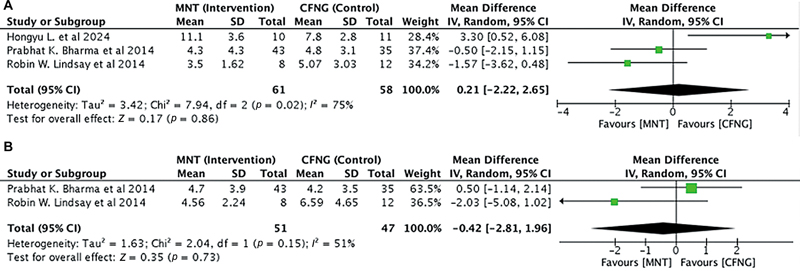
Three studies with 119 people (n = 119) looked at the dynamic lip angle symmetry (in degrees) between the vertical midline of the lower lip and the oral commissure. The donor nerves used in these studies were either MNT or CFNG. There was heterogeneity between the studies with I 2 > 50% ([Fig. 5A]). The analysis showed no significant difference between MNT and dynamic lip angle symmetry (pooled MD = 0.21, 95% CI = −2.22–2.65, p = 0.86; [Fig. 6A]). When comparing dynamic lip length symmetry (in mm), we obtained two studies (n = 98). Similarly, the MNT group showed no significant difference between MNT versus CFNG in dynamic lip symmetry length (in mm; pooled MD = −0.42, 95% CI = −2.81–1.96, p = 0.73). There was heterogeneity between the studies with I 2 > 50% ([Fig. 6B]).
Total Smile Improvement
Two studies (n = 98) were included to compare smile improvement in facial reanimation using MNT versus CFNG as the donor nerve. MNT was shown to have considerably higher improvement than CFNG. There was no heterogeneity between the studies with I 2 < 50%. The analysis showed no significant difference between MNT and total smile improvement (pooled MD = −1.96, 95% CI −4.12–0.19, p = 0.07; [Fig. 7]).

Secondary Outcomes
Quality of Life
Three retrospective studies (n = 99) assessed improvements in quality of life (QOL) following facial reanimation using the Face Clinimetric Evaluation (FaCE) instrument.[34] [35] [36] Patients who underwent free gracilis muscle transfer (FGMT) innervated by CFNG showed no statistically significant difference in FaCE score improvements compared with the MNT group.[35] In one study, 13 pediatric patients completed FaCE surveys, with preintervention and postintervention scores improving from 51.3 to 65.7, reflecting a statistically significant improvement. The average FaCE score improvement was 12.9 for CFNG and 17.7 for MNT.[36] Based on these studies, all three suggested that the QOL associated with the MNT procedure was generally higher than with CFNG, although two studies did not reach statistical significance. Thus, it can be concluded that MNT tends to be more favorable than CFNG in improving QOL.
Satisfaction
Two studies (n = 233) reported patient satisfaction scores following reanimation surgery.[37] [38] The masseter nerve gracilis transfer demonstrated favorable outcomes within the briefest recovery timeframe. In the CFNG group, five patients (2.8%, 3.1 ± 0.64) were unsatisfied and reported unsuccessful outcomes, while in the MNT group, one patient (5%, 3.45 ± 0.81) experienced failed results.[38] Another study by Hontanilla et al[37] reported that 16 patients (88.8%) were satisfied with MNT, while 8 patients (80%) were satisfied in the CFNG group. These studies suggest that satisfaction rates are generally higher with MNT compared with CFNG, with a lower incidence of dissatisfaction among MNT patients. However, one study noted a relatively higher rate of dissatisfaction in the MNT cohort, which may be due to differences in preoperative complexity.
Discussion
Facial nerve paralysis is a severe disorder marked by partial or full loss of facial nerve function, resulting in facial asymmetry, deformity, and functional impairment.[19] One of the most important decisions in managing this condition is deciding which motor nerve to supply the paralyzed side.[19] In bilateral paralysis cases, where both facial nerves lack functionality, alternative cranial nerves have been evaluated for reinnervation.[30] Recently, MNT has gained prominence as the preferred technique for facial reanimation.[8] [16] [22] MNT uses the masseter nerve's descending branch while leaving the proximal branches intact, preventing masseter muscle atrophy.[39]
The masseter nerve, the largest pure motor branch of the trigeminal nerve,[30] innervates the masseter muscle, which plays a crucial role in mastication. Its consistent anatomical structure, sufficient length, and proximity to the facial nerve branches[39] make it an ideal motor source for facial reanimation surgery.[11] [23] [24] [39] The motor branch innervating the masseter muscle lies on the muscle's undersurface, generally extending vertically downward along the posterior margin, positioned just beneath the zygomatic arch. The nerve is found approximately 11 mm below the zygomatic arch, 38 mm anterior to the tragus, and 13 mm deep within the masseter muscle.[4] [19] [40] Prior research indicates that the mean distance from the coronoid notch to the entrance of the masseter nerve is 32 mm.[39] During surgery, the masseter nerve is carefully dissected to achieve the necessary length for reinnervation.[38]
In contrast to MNT, the CFNG procedure involves connecting the motor branch of the facial nerve from the healthy, non-paralyzed side to a sural nerve graft. This technique carries the inherent risk of compromising facial nerve function on the unaffected side.[41] Additionally, CFNG is typically a multistage procedure, which increases the risk of failure.[14] The facial nerve's primary role is to provide motor innervation to the muscles responsible for facial expression. To identify the facial nerve branches on the paralyzed side, a periauricular incision is made, extending toward the modiolus until the desired branch is located,[1] usually found at the anterior border of the parotid gland.[42] The buccal or zygomatic branches are often chosen for coaptation with the cross-face sural nerve graft, although they can be challenging to distinguish anatomically.[30]
The surgical durations of both MNT and CFNG vary depending on their complexity and the surgeon's expertise. Data from previous studies show that the CFNG procedure takes approximately 80 to 90 minutes for the first stage and 150 to 180 minutes for the second stage. In contrast, the MNT procedure, performed in a single stage, typically requires 170 to 200 minutes. This suggests that MNT, while taking longer in a single session, may be more time-efficient overall compared with the multistage CFNG.[38] However, no significant differences were observed in total operative time when comparing the muscle transplantation component of both techniques.[30]
In a study by Snyder-Warwick et al, the masseteric nerve demonstrated an average of 5,289 myelinated fibers per square millimeter, compared with the 1,647 axons per square millimeter found in the CFNG, representing a 76% reduction in fiber density from the donor facial nerve. Neurotization using the masseteric nerve has proven to be a reliable technique for smile reanimation, producing robust, symmetrical,[28] and natural smiles with significant functional recovery.[18] These findings are in-line with our comprehensive comparison of both interventions, as summarized in this report ([Table 3]).
Abbreviations: CCV, commissural contraction velocity; CE, commissural excursion; CI, confidence interval; MD, mean difference.
Previous research indicates that smile asymmetry is often a primary concern for patients with facial paralysis, as symmetry is a crucial determinant of facial attractiveness. The masseter nerve transfer has been shown to improve both facial symmetry and oral commissure excursion[22] due to its strong motor input.[13] Studies by Bianchi et al have established that the normal range of commissural movement is between 7 and 22 mm, with a mean of 14 mm.[43] Clinical observations suggest that muscles innervated by the masseter nerve exhibit greater excursion[16] [44] compared with those utilizing CFNG. For instance, Roy et al reported that the masseter nerve transfer resulted in a greater smile excursion (10.0 mm) than CFNG (6.8 mm).[26] Additionally, quantitative assessments using tools such as FACEGram[12] [35] and FACIAL CLIMA[31] have shown that over 75% of patients undergoing masseter nerve transfer experience significant improvements in commissural excursion and velocity.[22] This finding supports our current study, which demonstrates the advantages of masseter nerve transfer in enhancing CE. Notably, the oral commissure movement on the side treated with CFNG was significantly less than that on the healthy side and the masseter nerve transfer group. However, some studies suggest that the CFNG procedure may facilitate a degree of spontaneous movement that is not achievable with the masseter nerve.
CCV is another important parameter for assessing facial symmetry[45] and is evaluated alongside CE[17] [42] [46] in tools like FACIAL CLIMA.[31] A recent study by Hontanilla et al (2018) compared MNT and CFNG, reporting mean CCV values of 35.0 ± 4.5 for MNT and 33.6 ± 5.4 for CFNG.[37] A closer alignment of the CCV on the reanimated side to that of the healthy side indicates a higher likelihood of surgical success. Our analysis corroborates this, revealing that the CCV on the reanimated side following MNT is statistically significantly higher than that observed in the CFNG group. Furthermore, in a separate analysis of CCV, the healthy side and the reanimated side using masseter-innervated nerve transfer showed no significant difference (23.8 vs. 31.3, p = 0.29). This suggests that successful outcomes are associated with the reanimated side achieving results that closely resemble those of the healthy side.
CE and CCV values were converted into recovery percentages to evaluate the improvement rates of each technique based on the paralyzed side's recovery relative to the healthy side.[22] [42] This study revealed that the MNT group exhibited significantly higher recovery rates for both commissural displacement and contraction velocity. An optimal smile is characterized by minimal differences between the reanimated and healthy sides; conversely, substantial discrepancies indicate asymmetrical movement.
Achieving symmetry in both static and dynamic facial expressions poses a considerable challenge in the reconstruction of facial nerve paralysis. Changes in oral commissural symmetry can be assessed through both horizontal and vertical dimensions, which collectively define the angle. A previous study demonstrated that gracilis free muscle transfer, powered by the masseteric nerve, led to significant improvements in horizontal length symmetry during both rest and smiling.[47] Symmetry was quantified by the ratio of oral commissure movement on the affected side compared with the healthy side, with significant enhancements noted during smiling.[12] Patients in the MNT group exhibited more substantial enhancements in static angle symmetry compared with those in the CFNG group. Furthermore, comparisons of dynamic angle differences in both groups indicated impressive improvements, with the masseter-innervated group achieving a larger angle. This group also demonstrated superior improvements in angle symmetry during both rest and smiling.[47] It has been suggested that a satisfactory smile is indicated when postoperative static and dynamic angles approach 90 degrees, and the smile excursion on the affected side closely approximates that of the healthy side.[48] However, it is unfortunate that the comparison of the two procedures in terms of static and dynamic lip symmetry did not reach statistical significance. This lack of significance may be attributed to various factors, including the patient's condition (unilateral or bilateral abnormalities), denervation time,[9] and the high level of dependence on the operator, who plays a critical role in determining the expected outcomes.
Facial paralysis is a serious condition that adversely affects patients' QoL and is linked to depression, making it an important issue in facial reanimation surgery.[2] [49] Patient-reported outcome measures, including the Facial Clinimetric Evaluation (FaCE) Scale, offer clinically significant insights into QoL enhancements and have been widely employed in the literature.[35] [50] The FaCE Scale serves multiple important clinical purposes, including assessing the natural progression of facial disability from the acute phase of paralysis through various recovery stages caused by different underlying factors. This tool enhances our understanding of patients' needs and their responses to various treatment modalities. Furthermore, the FaCE Scale complements clinician-administered instruments designed to quantify facial impairment.[25] [51]
In this study, patients who underwent the CFNG procedure did not show a statistically significant difference in FaCE scores compared with those who received MNT. One potential explanation for this finding is that the mean age of the MNT group was significantly higher than that of the CFNG group,[35] which is relevant since age can influence axonal density.[14] CFNG is considered an ideal choice for those patients who have a sufficiently strong contralateral facial nerve.[19] Previous research indicates that younger patients with severe facial paralysis tend to benefit more from early MNT, particularly in cases of traumatic injury.[25] However, other studies have suggested that patient age at the time of surgery does not significantly impact aesthetic or functional outcomes.[52]
This is an important aspect to consider the possibility of complication when comparing different techniques of facial reanimation. In fact, from previous studies, complication rates were not significantly different between groups. Some mild to severe complications might happen postoperatively and during the healing phase. These complications vary, including postoperative bleeding, hematoma, wound infections, the risk of wound dehiscence, muscle atrophy, and flap failure.[4] [47] [53] In the CFNG procedure, there is always the risk of damage to the function of the facial nerve, weakness of the smile on the nonparalyzed side, once the branch of the zygomatic or buccal nerve is transected for anastomosis. There will be numbness on the lateral aspect of the foot from the sural nerve harvest. If the deep peroneal nerve is accidentally transected, foot drop remains a possibility.[41] Whereas in the MNT procedure, minor synkinesis was also observed in the masseter nerve transfer group.[44] A previous study stated that there have been no reports of donor site morbidity related to loss of masseter muscle function and masseter muscle atrophy.[4] Although there is a possibility of various complications occurring, with good postoperative care, these complaints can be resolved, and rehabilitation is very important to begin around 6 weeks postoperatively, including massage, smile training or induction exercise, and muscle stimulation. Smile training in front of the mirror is quite important.[38]
This study has several limitations, including a small sample size and an unbalanced distribution of outcome parameters, which may affect the statistical significance of the results. This meta-analysis includes two studies[34] [35] with a potential overlap in patient cohorts, representing a minor limitation concerning the independence of data points. Nonetheless, the impact is anticipated to be minimal. Additionally, conducting head-to-head comparisons proved challenging during data collection with the predominance of retrospective studies, resulting in potential bias and limited ability to access broader outcomes such as axonal improvement and spontaneous smiles. Therefore, further comparative studies with larger sample sizes are necessary to provide more robust evidence regarding the benefits of the MNT procedure. Future research is expected to address the gaps identified in this review, particularly in areas where the findings were non-significant, by including a diverse patient population and employing standardized outcome measures to strengthen the evidence supporting the efficacy of MNT in facial reanimation surgery. Additionally, outcomes should be evaluated using reliable and standardized assessment parameters to ensure the validity of future studies.
Conclusion
In conclusion, various facial nerve reconstruction techniques are viable options for facial reanimation, considering the individual patient's circumstances and preoperative conditions. This meta-analysis highlights the significant advantages of MNT over CFNG procedures. Improvements in lip movement and smile functionality, as measured by critical parameters such as CE, CCV, and both static and dynamic symmetry, demonstrate that MNT is a highly preferred approach for facial reanimation. Additionally, secondary outcomes suggest that MNT may further benefit facial reanimation. However, more comprehensive data are needed to analyze these secondary outcomes in-depth.
Conflict of Interest
The authors declare that they have no conflict of interest.
Acknowledgment
We would like to thank all authors whose studies are included in our systematic review and meta-analysis.
Data Availability Statement
The data that support the findings of this study are available from the corresponding author upon reasonable request.
Contributors' Statement
I.L.P.: Conceptualization; formal analysis; methodology; supervision; validation; writing—review and editing.
K.E.S.S.: Data curation; investigation; software; writing—original draft.
I.F.A.: Project administration; resources; visualization; writing—review and editing; writing—original draft.
R.P.: Formal analysis; investigation; supervision; writing—review and editing.
C.D.K.W.: Formal analysis; methodology; software; supervision; writing—review and editing.
Ethical Approval
This article does not contain any studies with human or animal participants.
Informed Consent
Not applicable.
-
References
- 1 Hontanilla B, Marre D, Cabello Á. Facial reanimation with gracilis muscle transfer neurotized to cross-facial nerve graft versus masseteric nerve: a comparative study using the FACIAL CLIMA evaluating system. Plast Reconstr Surg 2013; 131 (06) 1241-1252
- 2 Özücer B, Çam OH. Effect of distal masseter to facial nerve transfer in paralytic patients with preserved facial nerve continuity on improving Scaled Measurement of Improvement in Lip Excursion (SMILE): A vectoral analysis. Turk Arch Otorhinolaryngol 2020; 58 (04) 249-253
- 3 Krishnan KG, Schackert G, Seifert V. Outcomes of microneurovascular facial reanimation using masseteric innervation in patients with long-standing facial palsy resulting from cured brainstem lesions. Neurosurgery 2010; 67 (03) 663-674 , discussion 674
- 4 Biglioli F, Frigerio A, Colombo V. et al. Masseteric-facial nerve anastomosis for early facial reanimation. J Craniomaxillofac Surg 2012; 40 (02) 149-155
- 5 Sforza C, Tarabbia F, Mapelli A. et al. Facial reanimation with masseteric to facial nerve transfer: A three-dimensional longitudinal quantitative evaluation. J Plast Reconstr Aesthet Surg 2014; 67 (10) 1378-1386
- 6 Hontanilla B, Marre D, Cabello A. Masseteric nerve for reanimation of the smile in short-term facial paralysis. Br J Oral Maxillofac Surg 2014; 52 (02) 118-123
- 7 Yang SF, Xie Y, Kim JC. Outcomes of facial symmetry and tone at rest after masseteric-to-facial nerve transfer. Facial Plast Surg Aesthet Med 2021; 23 (05) 357-361
- 8 Owusu JA, Truong L, Kim JC. Facial nerve reconstruction with concurrent masseteric nerve transfer and cable grafting. JAMA Facial Plast Surg 2016; 18 (05) 335-339
- 9 Kollar B, Weiss JBW, Kiefer J, Eisenhardt SU. Functional outcome of dual reinnervation with cross-facial nerve graft and masseteric nerve transfer for facial paralysis. Plast Reconstr Surg 2024; 153: 1178e-1190e
- 10 Lenz Y, Kiefer J, Dietrich F, Stark GB, Eisenhardt SU. Pre-operative masseter muscle EMG activation during smile predicts synchronicity of smile development in facial palsy patients undergoing reanimation with the masseter nerve: A prospective cohort study✰ . J Plast Reconstr Aesthet Surg 2019; 72 (03) 505-512
- 11 van Veen MM, Dusseldorp JR, Quatela O. et al. Patient experience in nerve-to-masseter-driven smile reanimation. J Plast Reconstr Aesthet Surg 2019; 72 (08) 1265-1271
- 12 Oh TS, Kim HB, Choi JW, Jeong WS. Facial reanimation with masseter nerve-innervated free gracilis muscle transfer in established facial palsy patients. Arch Plast Surg 2019; 46 (02) 122-128
- 13 Hontanilla B, Cabello A. Spontaneity of smile after facial paralysis rehabilitation when using a non-facial donor nerve. J Craniomaxillofac Surg 2016; 44 (09) 1305-1309
- 14 Bayezid KC, Joukal M, Karabulut E, Macek J, Moravcová L, Streit L. Donor nerve selection in free gracilis muscle transfer for facial reanimation. A systematic review and meta-analysis of clinical outcomes. J Plast Reconstr Aesthet Surg 2023; 82: 31-47
- 15 Woo SH, Kim YC, Kim J, Kwon S, Oh TS. Artificial intelligence-based numerical analysis of the quality of facial reanimation: A comparative retrospective cohort study between one-stage dual innervation and single innervation. J Craniomaxillofac Surg 2023; 51 (05) 265-271
- 16 Kannan RY, Neville C, Gwynn T, Young K, Venables V, Nduka C. Evaluation of masseteric nerve-based selective neurotization for multivectorial augmentation of the weak smile. JAMA Facial Plast Surg 2019; 21 (04) 340-341
- 17 Hontanilla B, Marré D. Comparison of hemihypoglossal nerve versus masseteric nerve transpositions in the rehabilitation of short-term facial paralysis using the FACIAL CLIMA evaluating system. Plast Reconstr Surg 2012; 130 (05) 662e-672e
- 18 Tzafetta K, Al-Hassani F, Pinto-Lopes R, Wade RG, Ahmad Z. Long-term outcomes of dual innervation in functional muscle transfers for facial palsy. J Plast Reconstr Aesthet Surg 2021; 74 (10) 2664-2673
- 19 Bianchi B, Copelli C, Ferrari S, Ferri A, Bailleul C, Sesenna E. Facial animation with free-muscle transfer innervated by the masseter motor nerve in unilateral facial paralysis. J Oral Maxillofac Surg 2010; 68 (07) 1524-1529
- 20 Telich-Tarriba JE, Orihuela-Rodríguez A, Rivera-Priego AL. et al. Changes in electrical activity of the masseter muscle and masticatory force after the use of the masseter nerve as donor in facial reanimation surgery. Indian J Plast Surg 2020; 53 (01) 59-63
- 21 Wang W, Yang C, Li W, Li Q, Zhang Y. Masseter-to-facial nerve transfer: Is it possible to rehabilitate the function of both the paralyzed eyelid and the oral commissure?. Aesthetic Plast Surg 2012; 36 (06) 1353-1360
- 22 Hontanilla B, Marre D. Masseteric-facial nerve transposition for reanimation of the smile in incomplete facial paralysis. Br J Oral Maxillofac Surg 2015; 53 (10) 943-948
- 23 Lu GN, Han R, Lee E, Byrne P, Boahene K. Predicting resting oral commissure tone outcomes following masseter nerve transfer in facial reanimation. Facial Plast Surg Aesthet Med 2021; 23 (04) 249-254
- 24 Sforza C, Frigerio A, Mapelli A. et al. Facial movement before and after masseteric-facial nerves anastomosis: A three-dimensional optoelectronic pilot study. J Craniomaxillofac Surg 2012; 40 (05) 473-479
- 25 Li T, Liu Y, Zhang S, Yang W, Zuo M, Liu X. Multiple model evaluation of the masseteric-to-facial nerve transfer for reanimation of the paralyzed face and quick prognostic prediction. Front Surg 2022; 9: 735231
- 26 Roy M, Corkum JP, Shah PS. et al. Effectiveness and safety of the use of gracilis muscle for dynamic smile restoration in facial paralysis: A systematic review and meta-analysis. J Plast Reconstr Aesthet Surg 2019; 72 (08) 1254-1264
- 27 Hontanilla B, Olivas-Menayo J, Marré D, Cabello Á, Aubá C. Maximizing the smile symmetry in facial paralysis reconstruction: An algorithm based on twenty years' experience. Facial Plast Surg 2021; 37 (03) 360-369
- 28 Jones RM, Victor JD, Conte MM. Detecting symmetry and faces: Separating the tasks and identifying their interactions. Atten Percept Psychophys 2012; 74 (05) 988-1000
- 29 Biglioli F, Colombo V, Tarabbia F. et al. Recovery of emotional smiling function in free-flap facial reanimation. J Oral Maxillofac Surg 2012; 70 (10) 2413-2418
- 30 Bae YC, Zuker RM, Manktelow RT, Wade S. A comparison of commissure excursion following gracilis muscle transplantation for facial paralysis using a cross-face nerve graft versus the motor nerve to the masseter nerve. Plast Reconstr Surg 2006; 117 (07) 2407-2413
- 31 Hontanilla B, Aubá C. Automatic three-dimensional quantitative analysis for evaluation of facial movement. J Plast Reconstr Aesthet Surg 2008; 61 (01) 18-30
- 32 Vincent AG, Bevans SE, Robitschek JM, Wind GG, Hohman MH. Masseteric-to-facial nerve transfer and selective neurectomy for rehabilitation of the synkinetic smile. JAMA Facial Plast Surg 2019; 21 (06) 504-510
- 33 Wells GA, Shea B, O'Connell D, Peterson J, Welch V, Losos M, Tugwell P. The Newcastle-Ottawa Scale (NOS) for assessing the quality of nonrandomised studies in meta-analyses. Ottawa Hospital Reasearch Institute. Published May 3, 2021. Accessed August 13, 2024. https://www.ohri.ca/programs/clinical_epidemiology/oxford.asp.
- 34 Lindsay RW, Bhama P, Weinberg J, Hadlock TA. The success of free gracilis muscle transfer to restore smile in patients with nonflaccid facial paralysis. Ann Plast Surg 2014; 73 (02) 177-182
- 35 Lindsay RW, Bhama P, Hadlock TA. Quality-of-life improvement after free gracilis muscle transfer for smile restoration in patients with facial paralysis. JAMA Facial Plast Surg 2014; 16 (06) 419-424
- 36 Hadlock TA, Malo JS, Cheney ML, Henstrom DK. Free gracilis transfer for smile in children: The Massachusetts Eye and Ear Infirmary Experience in excursion and quality-of-life changes. Arch Facial Plast Surg 2011; 13 (03) 190-194
- 37 Hontanilla B, Olivas J, Cabello Á, Marré D. Cross-face nerve grafting versus masseteric-to-facial nerve transposition for reanimation of incomplete facial paralysis: A comparative study using the FACIAL CLIMA evaluating system. Plast Reconstr Surg 2018; 142 (02) 179e-191e
- 38 Kalra GS, Kalra S, Gupta S. Facial reanimation using free functional muscle transfer: lessons learnt from a long term experience comparing innervation with cross facial nerve graft and masseter nerve. J Craniofac Surg 2022; 33 (08) e791-e796
- 39 Park H, Jeong SS, Oh TS. Masseter nerve-based facial palsy reconstruction. Arch Craniofac Surg 2020; 21 (06) 337-344
- 40 Hontanilla B, Qiu SS. Transposition of the hemimasseteric muscle for dynamic rehabilitation of facial paralysis. J Craniofac Surg 2012; 23 (01) 203-205
- 41 Peng GL, Azizzadeh B. Cross-facial nerve grafting for facial reanimation. Facial Plast Surg 2015; 31 (02) 128-133
- 42 Hontanilla B, Marre D, Cabello A. Cross-face nerve grafting for reanimation of incomplete facial paralysis: Quantitative outcomes using the FACIAL CLIMA system and patient satisfaction. J Reconstr Microsurg 2014; 30 (01) 25-30
- 43 Bianchi B, Copelli C, Ferrari S, Ferri A, Sesenna E. Use of the masseter motor nerve in facial animation with free muscle transfer. Br J Oral Maxillofac Surg 2012; 50 (07) 650-653
- 44 Wang WJ, Zhu WD, Tremp M. et al. Facial reanimation with interposition nerve graft or masseter nerve transfer: a comparative retrospective study. Neural Regen Res 2022; 17 (05) 1125-1130
- 45 Ueda K, Harii K, Yamada A. Long-term follow-up of nerve conduction velocity in cross-face nerve grafting for the treatment of facial paralysis. Plast Reconstr Surg 1994; 93 (06) 1146-1149
- 46 Hontanilla B, Vila A. Comparison of hemihypoglossal-facial nerve transposition with a cross-facial nerve graft and muscle transplant for the rehabilitation of facial paralysis using the FACIAL CLIMA method. J Plast Surg Hand Surg 2012; 46 (01) 25-31
- 47 Oyer SL, Nellis J, Ishii LE, Boahene KD, Byrne PJ. Comparison of objective outcomes in dynamic lower facial reanimation with temporalis tendon and gracilis free muscle transfer. JAMA Otolaryngol Head Neck Surg 2018; 144 (12) 1162-1168
- 48 Liang H, Yang Z, Ma N, Wang W, Li Y. Comparison of outcomes of facial reanimation between the use of cross-facial nerve graft and the masseteric nerve as the donor nerve for reinnervation of gracilis muscle flap transfer. J Craniofac Surg 2024; 35 (01) 172-176
- 49 Park JH, Park SO, Chang H. Facial reanimation using free partial latissimus dorsi muscle transfer: Single versus dual innervation method. J Craniomaxillofac Surg 2022; 50 (10) 778-784
- 50 Bhama PK, Weinberg JS, Lindsay RW, Hohman MH, Cheney ML, Hadlock TA. Objective outcomes analysis following microvascular gracilis transfer for facial reanimation: A review of 10 years' experience. JAMA Facial Plast Surg 2014; 16 (02) 85-92
- 51 Kahn JB, Gliklich RE, Boyev KP, Stewart MG, Metson RB, McKenna MJ. Validation of a patient-graded instrument for facial nerve paralysis: The FaCE scale. Laryngoscope 2001; 111 (03) 387-398
- 52 Liang H, Chen S, Yang Z. et al. Facial animation with free functional gracilis transfer innervated by the cross-facial nerve graft. J Craniofac Surg 2021; 32 (05) 1754-1757
- 53 Murphey AW, Clinkscales WB, Oyer SL. Masseteric nerve transfer for facial nerve paralysis a systematic review and meta-analysis. JAMA Facial Plast Surg 2018; 20 (02) 104-110
- 54 Snyder-Warwick AK, Fattah AY, Zive L, Halliday W, Borschel GH, Zuker RM. The degree of facial movement following microvascular muscle transfer in pediatric facial reanimation depends on donor motor nerve axonal density. Plast Reconstr Surg 2015; Feb; 135 (02) 370e-381e
- 55 Faris C, Heiser A, Hadlock T, Jowett N. Free gracilis muscle transfer for smile reanimation after treatment for advanced parotid malignancy. Head Neck 2018; Mar; 40 (03) 561-568
Correspondence
Publication History
Received: 19 October 2024
Accepted: 19 September 2025
Article published online:
30 January 2026
© 2026. The Author(s). This is an open access article published by Thieme under the terms of the Creative Commons Attribution License, permitting unrestricted use, distribution, and reproduction so long as the original work is properly cited. (https://creativecommons.org/licenses/by/4.0/)
Thieme Medical Publishers, Inc.
333 Seventh Avenue, 18th Floor, New York, NY 10001, USA
-
References
- 1 Hontanilla B, Marre D, Cabello Á. Facial reanimation with gracilis muscle transfer neurotized to cross-facial nerve graft versus masseteric nerve: a comparative study using the FACIAL CLIMA evaluating system. Plast Reconstr Surg 2013; 131 (06) 1241-1252
- 2 Özücer B, Çam OH. Effect of distal masseter to facial nerve transfer in paralytic patients with preserved facial nerve continuity on improving Scaled Measurement of Improvement in Lip Excursion (SMILE): A vectoral analysis. Turk Arch Otorhinolaryngol 2020; 58 (04) 249-253
- 3 Krishnan KG, Schackert G, Seifert V. Outcomes of microneurovascular facial reanimation using masseteric innervation in patients with long-standing facial palsy resulting from cured brainstem lesions. Neurosurgery 2010; 67 (03) 663-674 , discussion 674
- 4 Biglioli F, Frigerio A, Colombo V. et al. Masseteric-facial nerve anastomosis for early facial reanimation. J Craniomaxillofac Surg 2012; 40 (02) 149-155
- 5 Sforza C, Tarabbia F, Mapelli A. et al. Facial reanimation with masseteric to facial nerve transfer: A three-dimensional longitudinal quantitative evaluation. J Plast Reconstr Aesthet Surg 2014; 67 (10) 1378-1386
- 6 Hontanilla B, Marre D, Cabello A. Masseteric nerve for reanimation of the smile in short-term facial paralysis. Br J Oral Maxillofac Surg 2014; 52 (02) 118-123
- 7 Yang SF, Xie Y, Kim JC. Outcomes of facial symmetry and tone at rest after masseteric-to-facial nerve transfer. Facial Plast Surg Aesthet Med 2021; 23 (05) 357-361
- 8 Owusu JA, Truong L, Kim JC. Facial nerve reconstruction with concurrent masseteric nerve transfer and cable grafting. JAMA Facial Plast Surg 2016; 18 (05) 335-339
- 9 Kollar B, Weiss JBW, Kiefer J, Eisenhardt SU. Functional outcome of dual reinnervation with cross-facial nerve graft and masseteric nerve transfer for facial paralysis. Plast Reconstr Surg 2024; 153: 1178e-1190e
- 10 Lenz Y, Kiefer J, Dietrich F, Stark GB, Eisenhardt SU. Pre-operative masseter muscle EMG activation during smile predicts synchronicity of smile development in facial palsy patients undergoing reanimation with the masseter nerve: A prospective cohort study✰ . J Plast Reconstr Aesthet Surg 2019; 72 (03) 505-512
- 11 van Veen MM, Dusseldorp JR, Quatela O. et al. Patient experience in nerve-to-masseter-driven smile reanimation. J Plast Reconstr Aesthet Surg 2019; 72 (08) 1265-1271
- 12 Oh TS, Kim HB, Choi JW, Jeong WS. Facial reanimation with masseter nerve-innervated free gracilis muscle transfer in established facial palsy patients. Arch Plast Surg 2019; 46 (02) 122-128
- 13 Hontanilla B, Cabello A. Spontaneity of smile after facial paralysis rehabilitation when using a non-facial donor nerve. J Craniomaxillofac Surg 2016; 44 (09) 1305-1309
- 14 Bayezid KC, Joukal M, Karabulut E, Macek J, Moravcová L, Streit L. Donor nerve selection in free gracilis muscle transfer for facial reanimation. A systematic review and meta-analysis of clinical outcomes. J Plast Reconstr Aesthet Surg 2023; 82: 31-47
- 15 Woo SH, Kim YC, Kim J, Kwon S, Oh TS. Artificial intelligence-based numerical analysis of the quality of facial reanimation: A comparative retrospective cohort study between one-stage dual innervation and single innervation. J Craniomaxillofac Surg 2023; 51 (05) 265-271
- 16 Kannan RY, Neville C, Gwynn T, Young K, Venables V, Nduka C. Evaluation of masseteric nerve-based selective neurotization for multivectorial augmentation of the weak smile. JAMA Facial Plast Surg 2019; 21 (04) 340-341
- 17 Hontanilla B, Marré D. Comparison of hemihypoglossal nerve versus masseteric nerve transpositions in the rehabilitation of short-term facial paralysis using the FACIAL CLIMA evaluating system. Plast Reconstr Surg 2012; 130 (05) 662e-672e
- 18 Tzafetta K, Al-Hassani F, Pinto-Lopes R, Wade RG, Ahmad Z. Long-term outcomes of dual innervation in functional muscle transfers for facial palsy. J Plast Reconstr Aesthet Surg 2021; 74 (10) 2664-2673
- 19 Bianchi B, Copelli C, Ferrari S, Ferri A, Bailleul C, Sesenna E. Facial animation with free-muscle transfer innervated by the masseter motor nerve in unilateral facial paralysis. J Oral Maxillofac Surg 2010; 68 (07) 1524-1529
- 20 Telich-Tarriba JE, Orihuela-Rodríguez A, Rivera-Priego AL. et al. Changes in electrical activity of the masseter muscle and masticatory force after the use of the masseter nerve as donor in facial reanimation surgery. Indian J Plast Surg 2020; 53 (01) 59-63
- 21 Wang W, Yang C, Li W, Li Q, Zhang Y. Masseter-to-facial nerve transfer: Is it possible to rehabilitate the function of both the paralyzed eyelid and the oral commissure?. Aesthetic Plast Surg 2012; 36 (06) 1353-1360
- 22 Hontanilla B, Marre D. Masseteric-facial nerve transposition for reanimation of the smile in incomplete facial paralysis. Br J Oral Maxillofac Surg 2015; 53 (10) 943-948
- 23 Lu GN, Han R, Lee E, Byrne P, Boahene K. Predicting resting oral commissure tone outcomes following masseter nerve transfer in facial reanimation. Facial Plast Surg Aesthet Med 2021; 23 (04) 249-254
- 24 Sforza C, Frigerio A, Mapelli A. et al. Facial movement before and after masseteric-facial nerves anastomosis: A three-dimensional optoelectronic pilot study. J Craniomaxillofac Surg 2012; 40 (05) 473-479
- 25 Li T, Liu Y, Zhang S, Yang W, Zuo M, Liu X. Multiple model evaluation of the masseteric-to-facial nerve transfer for reanimation of the paralyzed face and quick prognostic prediction. Front Surg 2022; 9: 735231
- 26 Roy M, Corkum JP, Shah PS. et al. Effectiveness and safety of the use of gracilis muscle for dynamic smile restoration in facial paralysis: A systematic review and meta-analysis. J Plast Reconstr Aesthet Surg 2019; 72 (08) 1254-1264
- 27 Hontanilla B, Olivas-Menayo J, Marré D, Cabello Á, Aubá C. Maximizing the smile symmetry in facial paralysis reconstruction: An algorithm based on twenty years' experience. Facial Plast Surg 2021; 37 (03) 360-369
- 28 Jones RM, Victor JD, Conte MM. Detecting symmetry and faces: Separating the tasks and identifying their interactions. Atten Percept Psychophys 2012; 74 (05) 988-1000
- 29 Biglioli F, Colombo V, Tarabbia F. et al. Recovery of emotional smiling function in free-flap facial reanimation. J Oral Maxillofac Surg 2012; 70 (10) 2413-2418
- 30 Bae YC, Zuker RM, Manktelow RT, Wade S. A comparison of commissure excursion following gracilis muscle transplantation for facial paralysis using a cross-face nerve graft versus the motor nerve to the masseter nerve. Plast Reconstr Surg 2006; 117 (07) 2407-2413
- 31 Hontanilla B, Aubá C. Automatic three-dimensional quantitative analysis for evaluation of facial movement. J Plast Reconstr Aesthet Surg 2008; 61 (01) 18-30
- 32 Vincent AG, Bevans SE, Robitschek JM, Wind GG, Hohman MH. Masseteric-to-facial nerve transfer and selective neurectomy for rehabilitation of the synkinetic smile. JAMA Facial Plast Surg 2019; 21 (06) 504-510
- 33 Wells GA, Shea B, O'Connell D, Peterson J, Welch V, Losos M, Tugwell P. The Newcastle-Ottawa Scale (NOS) for assessing the quality of nonrandomised studies in meta-analyses. Ottawa Hospital Reasearch Institute. Published May 3, 2021. Accessed August 13, 2024. https://www.ohri.ca/programs/clinical_epidemiology/oxford.asp.
- 34 Lindsay RW, Bhama P, Weinberg J, Hadlock TA. The success of free gracilis muscle transfer to restore smile in patients with nonflaccid facial paralysis. Ann Plast Surg 2014; 73 (02) 177-182
- 35 Lindsay RW, Bhama P, Hadlock TA. Quality-of-life improvement after free gracilis muscle transfer for smile restoration in patients with facial paralysis. JAMA Facial Plast Surg 2014; 16 (06) 419-424
- 36 Hadlock TA, Malo JS, Cheney ML, Henstrom DK. Free gracilis transfer for smile in children: The Massachusetts Eye and Ear Infirmary Experience in excursion and quality-of-life changes. Arch Facial Plast Surg 2011; 13 (03) 190-194
- 37 Hontanilla B, Olivas J, Cabello Á, Marré D. Cross-face nerve grafting versus masseteric-to-facial nerve transposition for reanimation of incomplete facial paralysis: A comparative study using the FACIAL CLIMA evaluating system. Plast Reconstr Surg 2018; 142 (02) 179e-191e
- 38 Kalra GS, Kalra S, Gupta S. Facial reanimation using free functional muscle transfer: lessons learnt from a long term experience comparing innervation with cross facial nerve graft and masseter nerve. J Craniofac Surg 2022; 33 (08) e791-e796
- 39 Park H, Jeong SS, Oh TS. Masseter nerve-based facial palsy reconstruction. Arch Craniofac Surg 2020; 21 (06) 337-344
- 40 Hontanilla B, Qiu SS. Transposition of the hemimasseteric muscle for dynamic rehabilitation of facial paralysis. J Craniofac Surg 2012; 23 (01) 203-205
- 41 Peng GL, Azizzadeh B. Cross-facial nerve grafting for facial reanimation. Facial Plast Surg 2015; 31 (02) 128-133
- 42 Hontanilla B, Marre D, Cabello A. Cross-face nerve grafting for reanimation of incomplete facial paralysis: Quantitative outcomes using the FACIAL CLIMA system and patient satisfaction. J Reconstr Microsurg 2014; 30 (01) 25-30
- 43 Bianchi B, Copelli C, Ferrari S, Ferri A, Sesenna E. Use of the masseter motor nerve in facial animation with free muscle transfer. Br J Oral Maxillofac Surg 2012; 50 (07) 650-653
- 44 Wang WJ, Zhu WD, Tremp M. et al. Facial reanimation with interposition nerve graft or masseter nerve transfer: a comparative retrospective study. Neural Regen Res 2022; 17 (05) 1125-1130
- 45 Ueda K, Harii K, Yamada A. Long-term follow-up of nerve conduction velocity in cross-face nerve grafting for the treatment of facial paralysis. Plast Reconstr Surg 1994; 93 (06) 1146-1149
- 46 Hontanilla B, Vila A. Comparison of hemihypoglossal-facial nerve transposition with a cross-facial nerve graft and muscle transplant for the rehabilitation of facial paralysis using the FACIAL CLIMA method. J Plast Surg Hand Surg 2012; 46 (01) 25-31
- 47 Oyer SL, Nellis J, Ishii LE, Boahene KD, Byrne PJ. Comparison of objective outcomes in dynamic lower facial reanimation with temporalis tendon and gracilis free muscle transfer. JAMA Otolaryngol Head Neck Surg 2018; 144 (12) 1162-1168
- 48 Liang H, Yang Z, Ma N, Wang W, Li Y. Comparison of outcomes of facial reanimation between the use of cross-facial nerve graft and the masseteric nerve as the donor nerve for reinnervation of gracilis muscle flap transfer. J Craniofac Surg 2024; 35 (01) 172-176
- 49 Park JH, Park SO, Chang H. Facial reanimation using free partial latissimus dorsi muscle transfer: Single versus dual innervation method. J Craniomaxillofac Surg 2022; 50 (10) 778-784
- 50 Bhama PK, Weinberg JS, Lindsay RW, Hohman MH, Cheney ML, Hadlock TA. Objective outcomes analysis following microvascular gracilis transfer for facial reanimation: A review of 10 years' experience. JAMA Facial Plast Surg 2014; 16 (02) 85-92
- 51 Kahn JB, Gliklich RE, Boyev KP, Stewart MG, Metson RB, McKenna MJ. Validation of a patient-graded instrument for facial nerve paralysis: The FaCE scale. Laryngoscope 2001; 111 (03) 387-398
- 52 Liang H, Chen S, Yang Z. et al. Facial animation with free functional gracilis transfer innervated by the cross-facial nerve graft. J Craniofac Surg 2021; 32 (05) 1754-1757
- 53 Murphey AW, Clinkscales WB, Oyer SL. Masseteric nerve transfer for facial nerve paralysis a systematic review and meta-analysis. JAMA Facial Plast Surg 2018; 20 (02) 104-110
- 54 Snyder-Warwick AK, Fattah AY, Zive L, Halliday W, Borschel GH, Zuker RM. The degree of facial movement following microvascular muscle transfer in pediatric facial reanimation depends on donor motor nerve axonal density. Plast Reconstr Surg 2015; Feb; 135 (02) 370e-381e
- 55 Faris C, Heiser A, Hadlock T, Jowett N. Free gracilis muscle transfer for smile reanimation after treatment for advanced parotid malignancy. Head Neck 2018; Mar; 40 (03) 561-568